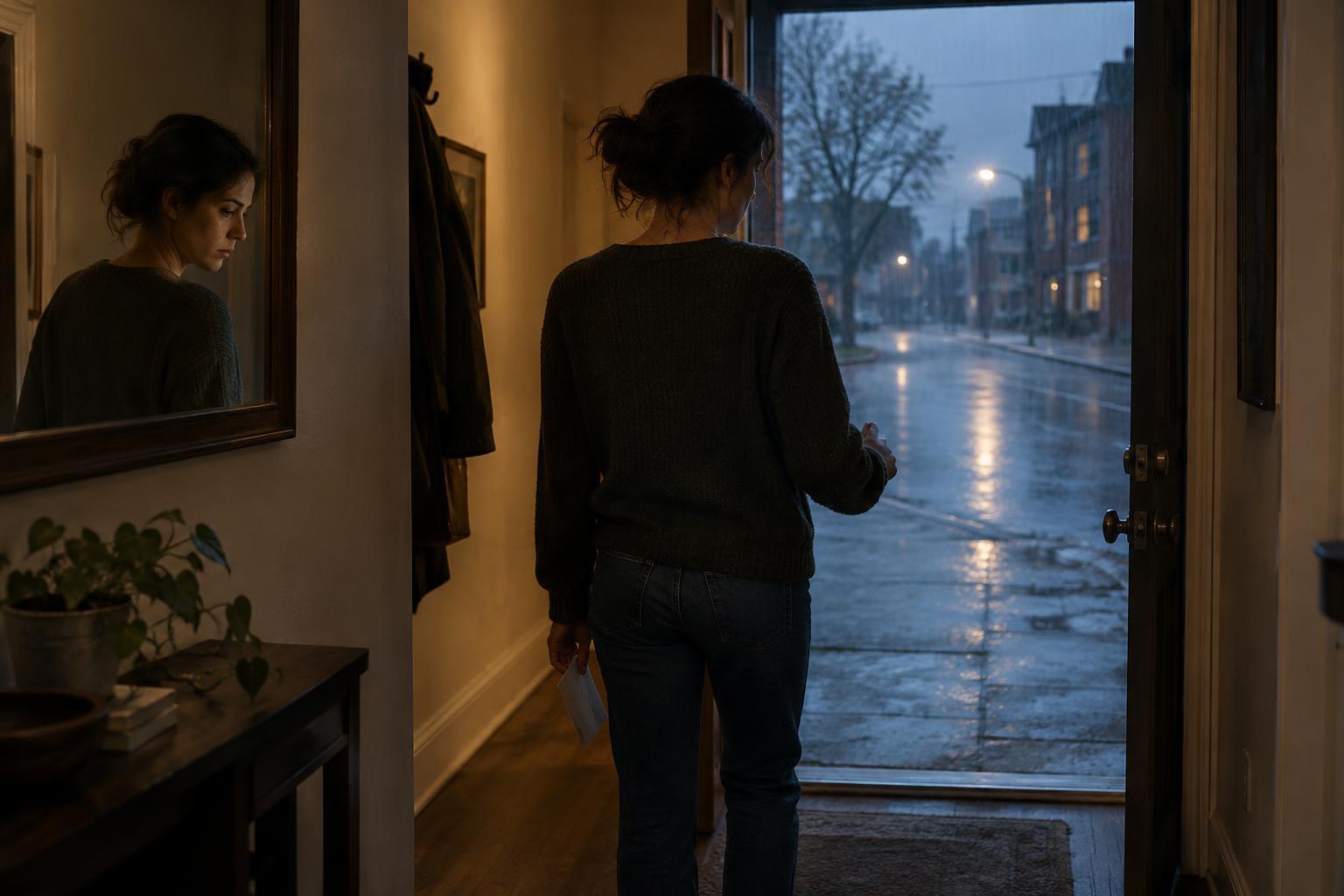
Stakes are the answer to “What happens if they fail?”
A goal tells the audience what a character is trying to do. Stakes tell them why the attempt matters. A character may need to retrieve a missing key, win an argument, or get across town before a door closes. None of those goals is inherently compelling. The story gains pressure when we understand what failure would change: someone loses access to a home, a friendship breaks, or a secret reaches the wrong person.
You do not need to threaten a life to create strong stakes. A small consequence can carry a film if it is specific to the character. Missing a dinner might be minor for one person and devastating for another who promised to show up after years of absence. The useful question is not “How big is the event?” but “What does this character stand to lose, and why can’t they simply shrug it off?”
Make the consequence concrete and personal
Abstract stakes are difficult to picture. “She might lose everything” asks the audience to supply the meaning. “If she misses the final train, she cannot be there when her brother leaves” gives the writer a clear outcome to build toward. The detail also suggests behavior: checking the time, taking a risky shortcut, or deciding whether to abandon someone who needs help. A concrete consequence creates choices rather than merely announcing importance.
Personal stakes come from the character’s values, obligations, and history. Two people can face the same external loss and react differently. If a character prizes independence, asking for help may feel costly even when it solves the immediate problem. If they fear repeating a parent’s mistake, a seemingly routine decision can carry emotional weight. Put enough of that context on the page for the audience to understand the pressure, but leave room for them to infer it from action.
Let the audience see the risk before the result
Stakes work best when viewers can anticipate a consequence while the outcome remains uncertain. Show the deadline on an invitation, establish who controls the only spare key, or let a character make a promise they may struggle to keep. These details give later obstacles meaning. If the consequence appears only after failure, the scene may feel arbitrary; if every detail is explained in advance, it may feel mechanical. Aim for enough clarity that the audience can worry alongside the character.
Dialogue can help, but it need not carry the entire burden. A character rehearsing an apology outside a door may tell us more about the relationship than a speech about how much it matters. In a screenplay, look for visible or audible evidence of the cost: a packed suitcase, an unanswered voicemail, a seat left empty. Choose details that belong naturally in the scene rather than props added solely to underline the theme.
Escalate by changing the choice, not just the danger
Raising stakes does not always mean adding a bigger threat. It can mean removing an easy solution or making success require a sacrifice. At first, a character might believe they can protect a friendship and keep a secret. Later, an obstacle forces them to choose between the two. The external goal remains understandable, but its emotional price rises. This kind of escalation gives the story movement without requiring every scene to be louder than the last.
Consider what the character risks at each turning point. Can they still walk away? What becomes harder if they continue? What would they have to admit or give up to succeed? The answers can guide scene construction. An obstacle is especially useful when it tests the value behind the goal: the character who claims honesty matters may get an easier route to success by lying. Now the audience is watching not only for an outcome, but for a decision.
Check whether each scene keeps the cost in view
During revision, write a simple sentence for the central goal and another for the consequence of failure. Then examine a few key scenes. Does each one clarify the goal, complicate the route, reveal a new cost, or force a meaningful choice? Not every scene needs an explicit reminder of the stakes. Repeating the same warning can flatten tension. What matters is that the audience can connect the immediate conflict to the larger consequence.
If a scene feels low-energy, resist adding a deadline automatically. First ask whether the character’s options differ in a meaningful way. A scene can be tense even when nobody raises their voice: someone must answer a question truthfully or preserve the last easy chance to leave. Clear stakes give that quiet moment a shape. We know what the character wants, what failure would cost, and why either choice may hurt.