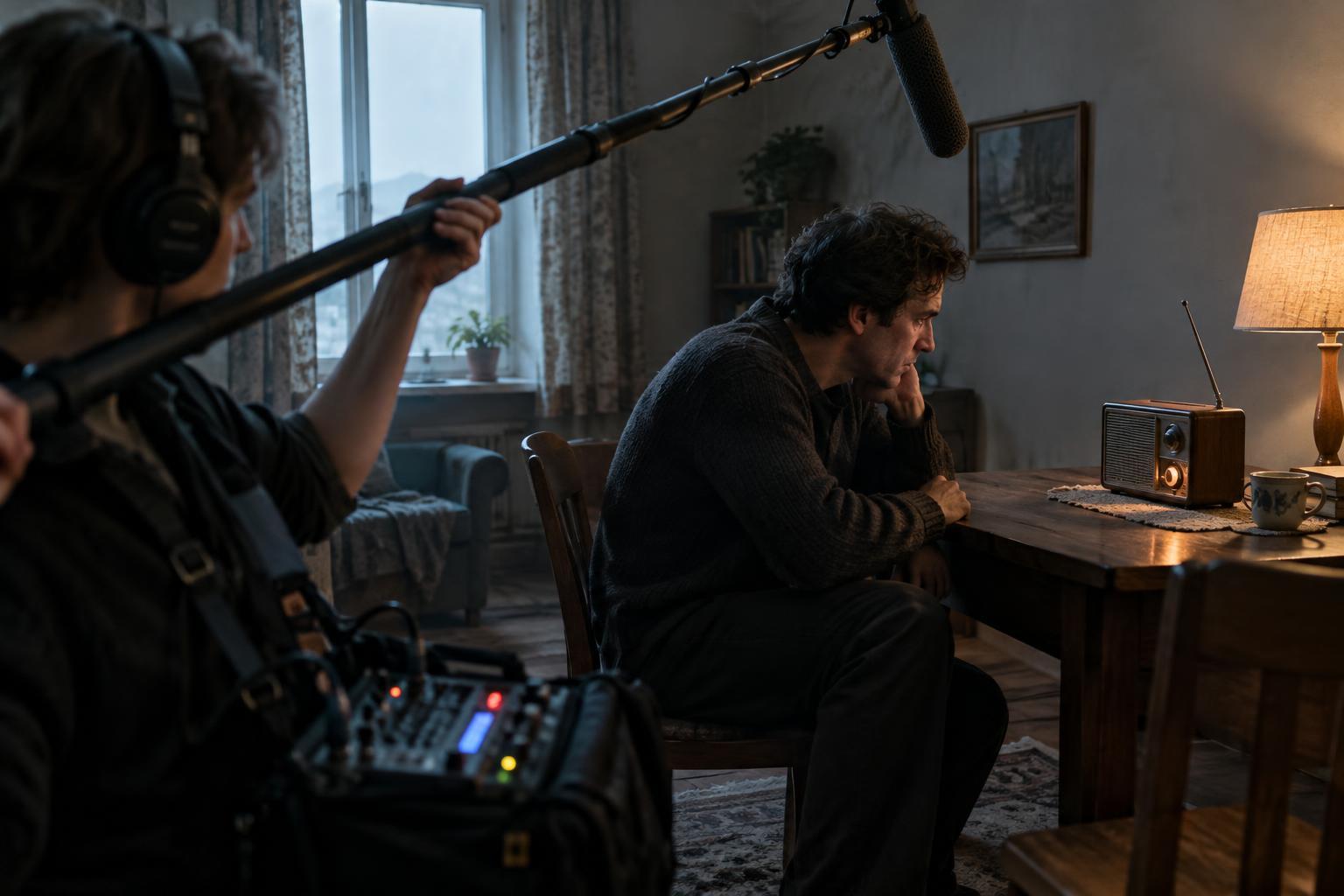
The boundary is the story world
Diegetic sound has a source within the world of the story. Characters might hear a door close, a phone ring or music playing from a car stereo. The source does not have to appear on screen: footsteps in the next room are still part of the scene’s world. Non-diegetic sound is presented to the audience without being heard by the characters, as with a conventional musical score or a narrator speaking from outside the action.
The distinction concerns the sound’s place in the story, not how it was recorded. A door slam added in post-production can be diegetic; music recorded at a real location can be non-diegetic if the finished film presents it as score. When judging an ambiguous sound, ask a simple question: could a character in this moment plausibly react to its source? That question is a useful starting point, though films can deliberately leave the answer uncertain.
What each kind of sound does for a scene
Diegetic sound gives characters something to notice, misinterpret or respond to. A distant knock can interrupt a conversation before anyone sees a visitor. The buzz of a light can make an otherwise quiet room feel uncomfortable. Because these sounds belong to the setting, they can also establish its size and texture: a voice heard through a wall suggests a different space from a voice spoken beside the camera.
Non-diegetic sound can guide an audience’s attention without changing what the characters know. A restrained score may lend unease to a routine walk, while silence where music was expected may leave room for a performance or a small background noise. Neither approach is automatically subtler or more effective. The useful choice depends on whose experience the scene emphasizes and what information the audience should have.
Music and voices can cross the line
Imagine a character turning on a radio. At first, the song sounds thin and distant, anchored to the speaker in the room. As the scene shifts into a montage, the same song may fill the soundtrack evenly and continue across locations. It began as diegetic music, but the mix now invites us to hear it as something broader than the radio alone. Reversing that move—letting full, score-like music resolve into a visible source—can make the audience reconsider what it has been hearing.
Voiceover needs similar care. A character’s spoken account over images is not necessarily audible to the people in those images, even if the speaker exists in the story. A remembered voice, an imagined conversation or a ringing that only one character seems to hear can complicate the categories further. Rather than forcing every sound into a rigid label, decide what the audience is meant to understand about who hears it. If uncertainty serves the scene, make that uncertainty feel intentional through performance, picture and sound.
Build the distinction into the mix
For a small production, begin with a sound map for each scene. List sounds the characters can hear, sounds intended only for the audience and any sounds that might move between those roles. Mark the moments when a character notices something. This helps a writer avoid an accidental reaction to score and gives the editor a clear reason to feature an off-screen cue.
In the edit, the treatment of a sound can help establish its source. Music from a nearby speaker might sit within the room’s ambience and change as a character moves away. A score cue can remain present across a cut to a different space. These are creative conventions, not strict rules: a filmmaker can break them, but doing so works best when the shift supports a change in point of view or emotion.
Listen once with your eyes closed, then watch with the sound at a modest level. Can you tell which cues belong to the room? Are important reactions motivated by something the characters could hear? Does a transition from source music to score happen at a meaningful moment? These checks are less about technical perfection than about keeping the audience oriented while leaving space for surprise.
Let the audience hear with purpose
The strongest sound choice is not always the most noticeable one. A scene may need a clear, diegetic warning that a character ignores; another may need a non-diegetic cue that gives the audience a feeling the character cannot name. Start with the relationship between listener and source, then decide whether to confirm it, shift it or keep it open. That relationship is what turns a sound from background detail into storytelling.