Know what the new shot contributes
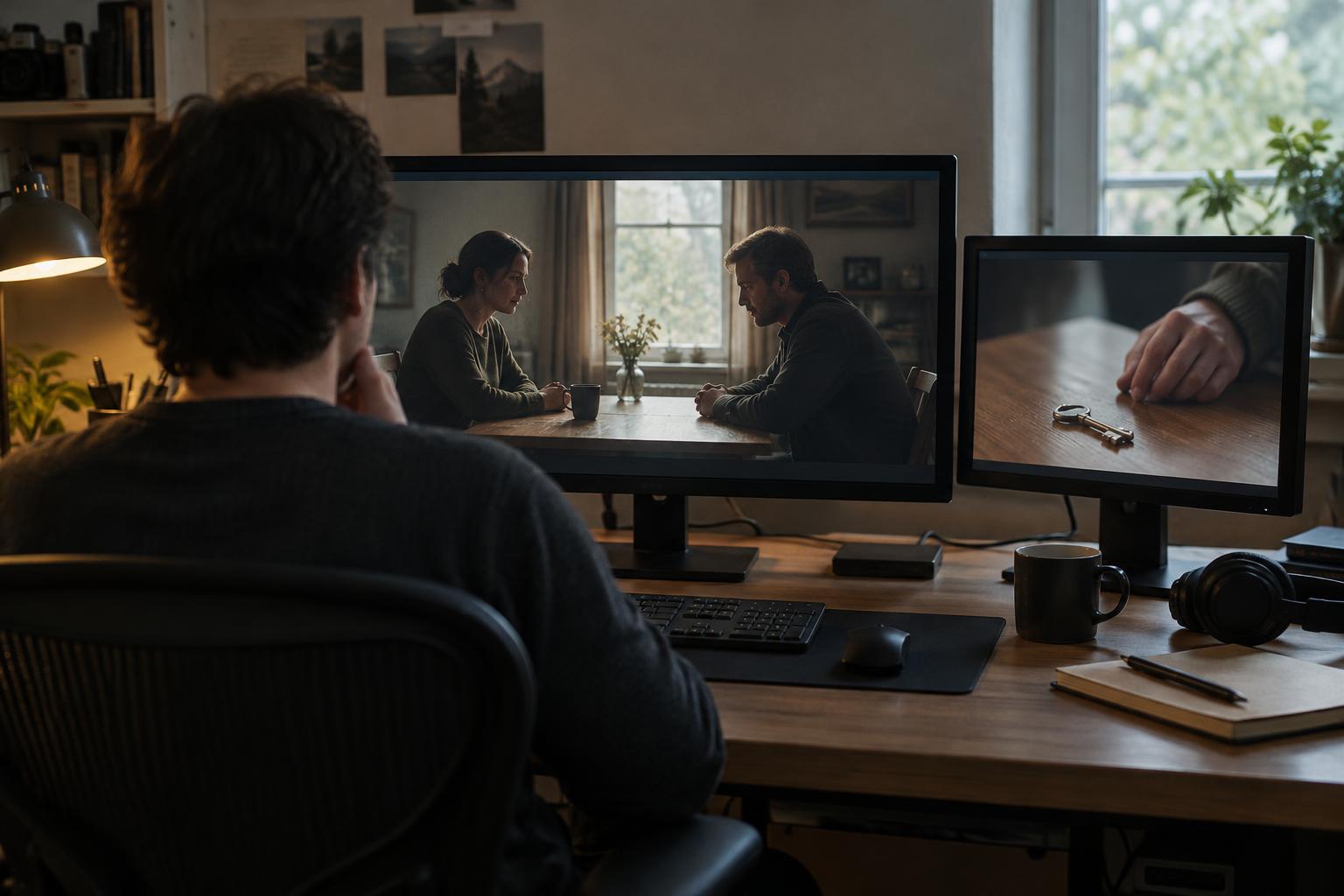
A cutaway briefly leaves the scene’s main action to show something related: a listener’s reaction, a clock across the room, or the empty doorway a character keeps watching. An insert moves in on a specific detail, such as a hand turning a key or a name on an envelope. The terms can overlap in casual use, but the useful distinction is what each shot asks the audience to notice.
Either shot can cover a change in performance, shorten a pause, or bridge two takes. Those are legitimate editing uses. But a shot earns its place more securely when it also delivers information, directs attention, or changes our understanding of a moment. Before adding one, finish the sentence: “We need to see this because…” If the only answer is “the main shot doesn’t work,” find out why it doesn’t work first.
Diagnose the scene before covering it
Watch a rough version built mostly from the scene’s central action. Is the objective clear? Can viewers follow who wants what, where people are, and what changes by the end? If a conversation feels repetitive, an insert of a coffee cup will not make the exchange progress. If a character’s decision seems unmotivated, cutting to a worried face may suggest feeling without supplying the missing cause.
Separate a storytelling problem from a timing problem. A scene may have a sound beginning and ending but contain a long stretch of movement that can be compressed. A cutaway to someone waiting could carry that compression while preserving the sense of elapsed time. By contrast, if the scene has no meaningful turn, shortening it may only reveal the gap more quickly. Consider changing the dialogue, action, or scene structure rather than asking supplementary footage to do that work.
A simple test is to remove every cutaway and insert from the rough cut, then watch it again. The scene need not be polished, but its essential action should still make sense. Add the other shots back one at a time. If removing a shot creates confusion or loses an important feeling, it has a clear job.
Give the audience a reason to look away
The strongest cutaways are connected to a character’s attention or to a question the scene has raised. During an argument about whether to leave, a shot of a packed bag by the door can make an earlier decision visible without another line of dialogue. A listener who stops reaching for that bag may then tell us something different. These images are not decoration; they participate in the exchange.
Timing changes meaning. Show an insert of an unsigned form before a character agrees, and the audience may anticipate a choice. Show it afterward, and the same detail may complicate what they just heard. A reaction shot held too early can announce an emotion before the performance has earned it; held too late, it may simply repeat what the dialogue already told us. Try the shot at several points and ask what new thought each placement creates.
Be sparing with details that carry no consequence. A close-up implies importance, so an insert of an object the story never returns to can send viewers searching for a clue that is not there. Not every detail needs a payoff, but it should at least strengthen the scene’s mood, perspective, or immediate action.
Plan coverage that will actually cut together
On set, record the full action before collecting attractive fragments. For an insert, note which hand holds an object, its position at the start and end of the action, and the direction it moves across the frame. For a cutaway reaction, give the performer something specific to hear or observe, and capture enough time before and after the reaction to place the edit naturally. Matching light, eyelines, and screen direction matters when the shots are meant to share a continuous moment.
Sound deserves the same care as picture. Continuous room tone and a clean recording of the scene’s dialogue give an editor room to move a visual cut without making the audio jump. Letting a voice continue over an insert can keep the dramatic focus on the speaker while revealing a detail elsewhere. If an object makes a meaningful sound, capture that sound clearly rather than assuming the picture alone will communicate the action.
Useful coverage need not mean filming every object in the room. Make a short list based on the scene’s questions: What does a character notice? What action may need shortening? Which detail changes our interpretation? That list produces more adaptable material than a collection of close-ups chosen only because they look cinematic.
Use the final cut to check the scene’s honesty
In the edit, watch for cuts that seem to flee a difficult moment. If the camera leaves a face precisely when a decision should register, ask whether the audience needs to stay with that performance. Sometimes an uncomfortable pause is the scene, not a flaw to cover. Keep a cutaway when it sharpens the moment; reconsider it when it merely prevents viewers from noticing that the moment is missing.
A practical final pass is to name the purpose of each supplementary shot: orientation, emphasis, reaction, compression, or transition. More than one purpose is welcome, but “it makes the edit busier” is not enough. Cutaways and inserts work best as choices about what viewers should understand and feel—not as camouflage for a scene that has yet to find its point.